Our Blog
Weekly reflections, updates, and news about our St. Stephen’s Community.
The Trinity: It’s All About Community
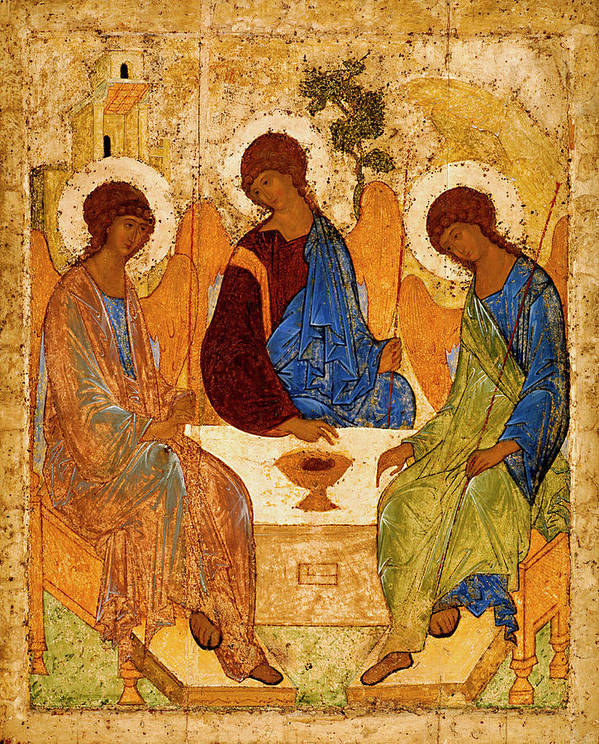
A famous icon of the Trinity is drawn to depict three figures gathered at table with the viewer as the fourth. At the heart of the doctrine of the Trinity is the conviction that God’s essence includes community, it seems to suggest.
On Sunday we will mark Trinity Sunday. It always follows Pentecost. The Spirit of God blows us into community. At St. Stephen’s the season after Pentecost means it is time for the summer experiment. These are trials and innovations which we try on for a season to see if they fit. Sometimes they stay, sometimes we learn from our failures.
This Sunday we begin the 2023 summer experiment which is designed to foster and deepen our connections with one another in community. We are coming together in space, in story, and in roles. You will notice on Sunday that six pews have been removed from the back of the church, inviting us to move closer to the front. We will also be setting up hospitality in the back of the church so that we can linger, even when the heat tops 90 degrees outside.
We are also encouraging everyone to wear their name tag and to greet someone at the peace that you do not know, calling them by name. We are also asking a member of the vestry to extend welcome each Sunday so that the congregation may match faces with names.
Our hope is that through this experiment our congregation will come to know each other a bit more and can deepen our sense of community.
-The Reverend Lisa Hunt, Rector
I Have Decided to Follow Jesus
At its inception, the Christian Church was viewed by the Roman Empire as a sect within Judaism and was thereby protected from Roman persecution. Two historical events united to dissolve Christian protection from Rome: the Bar Kockba revolt in Jerusalem which led to the destruction of the second Temple and the theological development within the Church of understanding Jesus as the incarnation of God. The Romans were cracking down on Christians because they were not willing to share in the cult of the emperor in which Caesar is Lord. The Jewish people as monotheists could not embrace a claim of human divinity. Christians, therefore, became food for the lions.
The choice to follow Jesus in the first two centuries of the common era was a radical one. It could mean life or death.
Recently, another survey came out describing the decline in the adherence and practice of religion in America. Commentators noted the increasing secularization of our country. Religious adherence is becoming increasingly uncommon culturally. That means Christian faith will be more of a deliberate choice…by individuals, families, and communities.
On Sunday at our single service at 9:30 a.m., we will celebrate the birth of the Church at Pentecost and the gift of the Holy Spirit. We will also welcome Brandon Sear, a man who is in his fifties, into our shared life in Christ. Brandon is making an adult decision to follow Jesus. His response to Christ’s calling on his life demonstrates to us all our shared responsibility to decide each day to follow our Lord. We share too in the life of the Spirit.
-The Reverend Lisa Hunt, Rector
Sometimes I Feel Like a Motherless Child…a Long Way from Home
These are the opening lyrics of a nineteenth century lament of a young enslaved child being sold away from his or her mother to a white person as property. The rendition by Odetta is particularly haunting; you can listen here:
I recall when my mother died and the depths of my sorrow, but then, my mother was in her mid-eighties and I was in my fifties. The pain of separation, while different in degree, resonates for me.
Jesus said, “I will not leave you orphaned; I am coming to you. In a little while the world will no longer see me, but you will see me; because I live, you also will live. On that day you will know that I am in my Father, and you in me, and I in you”. John 15:18-20.
Spiritual loss is healed by lament and the assurance of God’s presence in and among us; the product is resilience. It is often manifested most clearly in song.
Recently I attended a training conducted by William Barber of the Poor People’s Campaign: A National Call for Moral Revival. One of the leadership roles within each chapter is that of a theomusicologist. Each team requires an artist who can create and lead songs to lament, bind up, encourage and challenge. Music reminds us that we are not alone, even when we feel most desolate. When we sing, we know we are not alone or abandoned. We have strength to carry on.
-The Reverend Lisa Hunt, Rector
Growth Surprises
It seems so often that when we think about growth–spiritual, emotional, physical–we assume that we need to have a 9-step “refuse to lose” mentality. We set the goal; we determine the plan; we work the plan. Control and results are completely up to us. Praise and blame are also squarely on our own shoulders.
Recently, I cleared out my vegetable bed to plant a few peppers, eggplants, and herbs. It looked neat and inviting. Yesterday I went out and observed patches of other plants emerging. Some people might call these weeds. I would too, generally, but now I see them as surprise growth. Out of my control, weeds are going to grow. (Of course, I will pull them eventually!)
I am reminded of the parable of Jesus about the farmer who plants and goes to sleep. The plants emerge. He knows not how. So is the kingdom of God.
-The Reverend Lisa Hunt, Rector
Remember How We….
I am taking a memory enhancement course offered by Amazing Place, a non-profit ministry partner of ours whose mission is to care for folks with dementia and their families, along with a parishioner at St. Stephen’s. The class is designed for people “north of fifty” to learn techniques to strengthen short-term memory.
In addition to visualizing pictures to connect people and actions to be able to assist recall, the evocation of emotions and stories are crucial tools in memory. We remember feelings. As Maya Angelou once said, “At the end of the day people won’t remember what you said or did, they will remember how you made them feel.”
The most important thing I have learned in this class, however, is that your short-term memory is a matter of attention and choice. To remember we focus and choose to hold the information in our minds. Another way of saying this may be that we learn it by heart.
This Sunday’s gospel takes us to the road to Emmaus where two of Jesus’ friends encounter the Risen Lord. The Risen One invites them to remember Jesus’ teaching of the prophets and Torah and in the breaking of the bread, they recall who he is. They remember.
May we attend and recall as well.
-The Reverend Lisa Hunt, Rector
Death and Resurrection: the Heart of our Faith
This week in the school chapel services, we focused on the power of darkness and light, death and resurrection which seemed fitting for the first week of Easter. I asked the children to talk about their experience of the dark and death. Little did I realize that two of our students had experienced the death of parents this year. The recollection of their grief was real for these students ; they shared the dismay of the women who went to Jesus’ tomb. They could not hear the stories of transformation which came with resurrection because their loss was consuming.
In the Montessori based curriculum of the Catechesis of the Good Shepherd, the adult guides are instructed to always tie the crucifixion to the resurrection. Jesus died and was raised. As Christians we must pair the two; death without resurrection is unbearable; resurrection without death is superficial.
The ancient church used the Great Fifty days of Easter to instruct the newly baptized in the mysteries of faith; it was a period referred to as mystagogy. The chief mystery of our faith is the reality of death and resurrection as they are revealed to us in Jesus.
During these Fifty Days, during the 9:30 a.m. Sunday Forum, we will be offering a four session series on the last things—preparing for our own death and those whom we love by learning about wills, medical powers of attorney, living wills, and funerals. We do this in the sure and certain hope of resurrection. In our lives we know the truth of both death and resurrection.
-The Reverend Lisa Hunt, Rector
Cocks crowing and Other Signs
Last week I awoke at 3:00 a.m. to what I thought was a child crying in distress. Always a mother, I roused myself from a sound sleep to ensure that I wasn’t dreaming and that I would be ready to respond. I listened again. A soprano like moan that sounded and then became quiet emanated from outside my house and down the street. I strained to hear once more.
It was a rooster.
Irritated that my slumber was interrupted, the crows only got louder as the sun rose more. This cock had raised my cockles!
Listening to the telling of the Passion on Palm Sunday, I thought of my neighborhood rooster and Peter’s denial of Jesus. Despite Peter’s certainty that he would never abandon him, Peter denies Jesus three times before the cock crows. What self-delusions do I entertain in a similar vein? What prideful affirmations do I hold that I need to have punctured?
In case we didn’t reflect deeply enough, the Church invites us to hear this tale again on Good Friday. Peter’s denial of Jesus is there in case we missed it the first time. How do we fail to commend or acknowledge the faith that is in us? When do we shun our relationship to Christ?
Peter never forgot his denial of Jesus. When Peter was due to be killed by the Roman government by crucifixion, he asked to be hung upside down on a cross. The Church also remembers this rooster in its symbolism. In the 9th century, Pope Nicholas made the rooster official. His decree was that all churches must display the rooster on their steeples or domes as a symbol of Peter’s betrayal of Jesus. In accordance with the decree, churches started using weathervanes with the rooster.
Symbols always carry more than one meaning, however. The Church began also using the rooster as a symbol of Christ, like the lamb, emphasizing its connection to light and resurrection. The rooster announces that light follows the night.
As we walk the way of the cross together, may we be awakened by the rooster of denial and light!
-The Reverend Lisa Hunt, Rector
Life in the Garden is Brutal
This weekend we begin the Holy Week journey to Jerusalem where Jesus will eat Passover, be crucified, die, be buried and be raised. There is so much drama in the Passion Narrative—love, betrayal, fear, abandonment, grief, anger, pride, doubt, violence, injustice. As I have lived my life and listened to yours this week and that of the world, my attention is drawn to the garden of Gethsemane.
Jesus often went to that garden to hang out with his friends, to be alone, and to pray. It was one of his sacred places. On what he suspected would be the night before his arrest, Jesus took his closest disciples with him to pray. The gospel writer of Matthew quotes Jesus this way: “’My soul is overwhelmed with sorrow to the point of death. Stay here and keep watch with me.’ Going a little farther, he fell with his face to the ground and prayed, ‘My Father, if it is possible, may this cup be taken from me. Yet not as I will, but as you will.’”(Matthew 26:38-39).
In light of events at the Texas State Legislature this week attacking the children of the LGBTQ community and their physicians; the debates about voter access; the school shooting in Nashville; the indictment of the former President; and the process of the State’s takeover of HISD, my soul is overwhelmed with sorrow to the point of dismay/despair, if not death. Yours may be too.
Jesus does not shy away from his despair, grief and fear. Instead, while his brothers in faith abandon him, he takes all his feelings to God in prayer. His desperate cry to God includes the hope that these trials will pass him by; he nonetheless asks for strength to relinquish his ego and to be grounded in God’s being…”not as I will, but as you will.”
Like Jesus, we face trials, abandonment, persecution, fear and despair. Taking him as our Lord and Savior means that we trust in his model of grace and love. May we too have the courage to live as we pray…not my will, but Yours.
-The Reverend Lisa Hunt, Rector
The Cure for Loneliness
Loneliness is on the rise in the United States. A recent study by the insurance company, Cigna, found that 3 in 5 Americans report being lonely–feeling left out, misunderstood, lacking companionship. Loneliness is linked to anxiety, depression, heart disease, and shortened life span. Loneliness can affect people of all ages.
My son’s mother in law gave me a present for Christmas that I initially dismissed–a device produced by Meta which allows for video calls with various embellishments. I don’t spend time on social media. I set it aside. Yaya, however, recognized a power tool when she saw one.
Utilizing What’s App, my son was able to download my contact information onto the device he received for Christmas and his contact information onto my device. Voila! My grandchildren, ages 8 and 4, were suddenly able to call me without the assistance of their parents. As homeschooled farm kids, my grandchildren get lonely. As a priest whose work/life balance is often out of kilter, I get lonely too. Our Christmas tools enable us to connect and these calls foster joy and connection.
Throughout this Lenten season our gospel lessons have centered on folks who are experiencing the pain of loneliness. Nicodemus is isolated in his spiritual curiosity, cut off because of his professional status from meeting with Jesus in the daylight. The woman at the well is lonely because of her status and social marginalization. This week we encounter the man born blind, whose disability and healing isolate him because of the fear of others. In each case, Jesus connects. The power of relationships bridges the chasm of loneliness.
Jesus invites us to connect with him and each other. Health and healing are to be found in the joy of relationships. Redemption can look like a conversation. The wonder of this season is that while we enter the Lenten wilderness alone, we emerge connected.
-The Reverend Lisa Hunt, Rector
What Prevents You from Starting Over or Beginning Again?
This was the question posed yesterday in the excellent Lenten meditation cards created by Sanctifedart which St. Stephen’s has shared for home observance. Each day of Lent a question is posed for reflection and a prayer is offered in relation to the theme.
This week I was with a group of clergy colleagues who were determining the next steps for an organization of which we are a part. The question before us was whether or not we wanted to begin again. A need for defined purpose and direction was the objective for the day long meeting. Did we want to start over? Did we want to begin again? An option on the table was to fold the organization, but there was great resistance. One colleague observed that we are coming out of a pandemic and it may be too soon to fold. Others noted that several organizations of which they were a part were in the midst of re-evaluating mission and direction in a post-pandemic world.
What prevents us from starting over or beginning again? For some of us fear is a driving obstacle, for others it may be disillusionment. Disappointment,exhaustion, burnout, cynicism, doubt, laziness could also contribute to our hesitancy. Some of us like going in circles, sounding like broken records.
“Behold, I make all things new, ” proclaims God at the culmination of time (Revelation 25:1). Ever the Creator, God begins again.
Lent is a season of letting go– of actions, attitudes and feelings that keep us stuck. We are invited to begin again. Anew.
-The Reverend Lisa Hunt, Rector